
An airy sponge drowned in three kinds of milk until it becomes something between cake and custard — cold, dripping, and impossible to stop eating.
Tres leches breaks the first rule of baking — never let a cake get soggy — and turns the crime into a masterpiece. A light, airy sponge is pierced all over and flooded with a mixture of condensed, evaporated, and fresh milk, then chilled until every crumb is saturated. What comes out of the fridge isn’t soggy at all: it’s a cold, trembling, milk-drunk cloud under a blanket of whipped cream. It’s the birthday cake of half a continent, and once you understand the sponge, it’s nearly foolproof.
Before You Crack the Eggs
- The “three milks” are sweetened condensed, evaporated, and whole milk (or cream) — each does a different job.
- The sponge must be egg-foam based and slightly dry — that structure is what absorbs the flood without collapsing.
- Both Mexico and Nicaragua claim the cake; the condensed-milk industry helped spread it across all of Latin America.
- The soak is non-negotiable: at least 4 hours, ideally overnight. Tres leches is better on day two.
- Active work is about 30 minutes — the fridge does the rest.
A Cake With Two Birth Certificates
Milk-soaked desserts are old news in Europe — think trifles and rum-soaked sponges — but tres leches as we know it is a Latin American invention with two proud claimants. Nicaragua considers it a national treasure and has records of milk-soaked cakes going back generations. Mexico points to recipes printed on cans of Nestlé condensed milk in the mid-twentieth century, which carried the cake into every kitchen from Monterrey to Buenos Aires. The truth is probably both: an old idea, industrialized milk, and a continent that knows a good thing when it tastes one.
Today it’s the default celebration cake across Latin America and much of the United States — the centerpiece of quinceañeras, birthdays, and Sunday lunches. Every family has a ratio, every bakery a secret (a splash of rum here, a fourth milk there — the cuatro leches adds dulce de leche), and everyone agrees on one thing: it must be served properly cold.
Break the rule. Soak the cake. Serve it cold and watch it disappear.
Why Three Milks — and What Each One Does
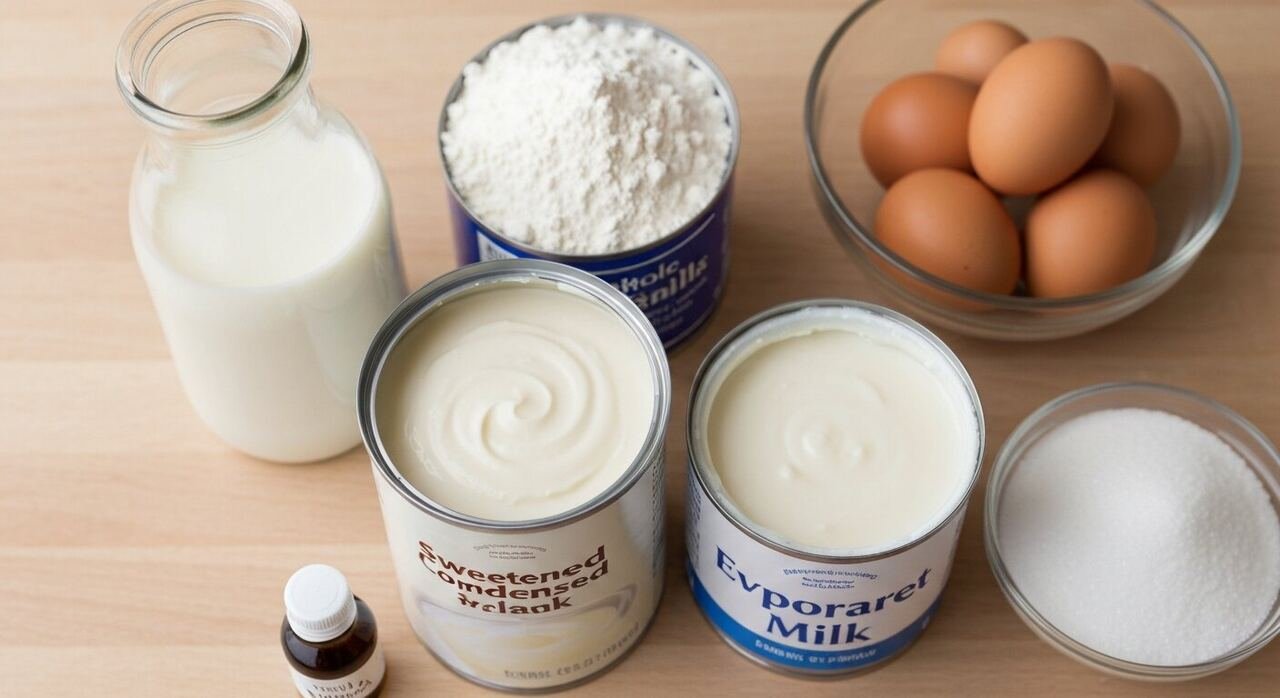
The genius of tres leches is that the three milks aren’t interchangeable — they’re a team. Condensed milk brings sweetness and body, evaporated milk brings concentrated dairy flavor without extra water, and fresh milk (or cream) loosens the mixture so it can travel into every crumb. Mix any two and the cake is either cloying or thin; together they land exactly right.
| Milk | What it is | What it does |
|---|---|---|
| Sweetened condensed | Milk cooked down with sugar | Sweetness & silky body |
| Evaporated | Milk with 60% of water removed | Deep dairy flavor, no dilution |
| Whole milk / cream | The fresh one | Thins the soak so it penetrates |
The Sponge Is the Whole Game
A cake that drinks a quart of milk without turning to mush needs architecture. That’s why tres leches uses a sponge — leavened almost entirely by whipped egg whites folded into a yolk batter. The baked result is airy, springy, and slightly dry, with thousands of tiny air pockets that act like a honeycomb: structure that holds, space that absorbs. A buttery or oil-based cake would seal itself against the milk and then collapse into pudding. The sponge drinks and stands.
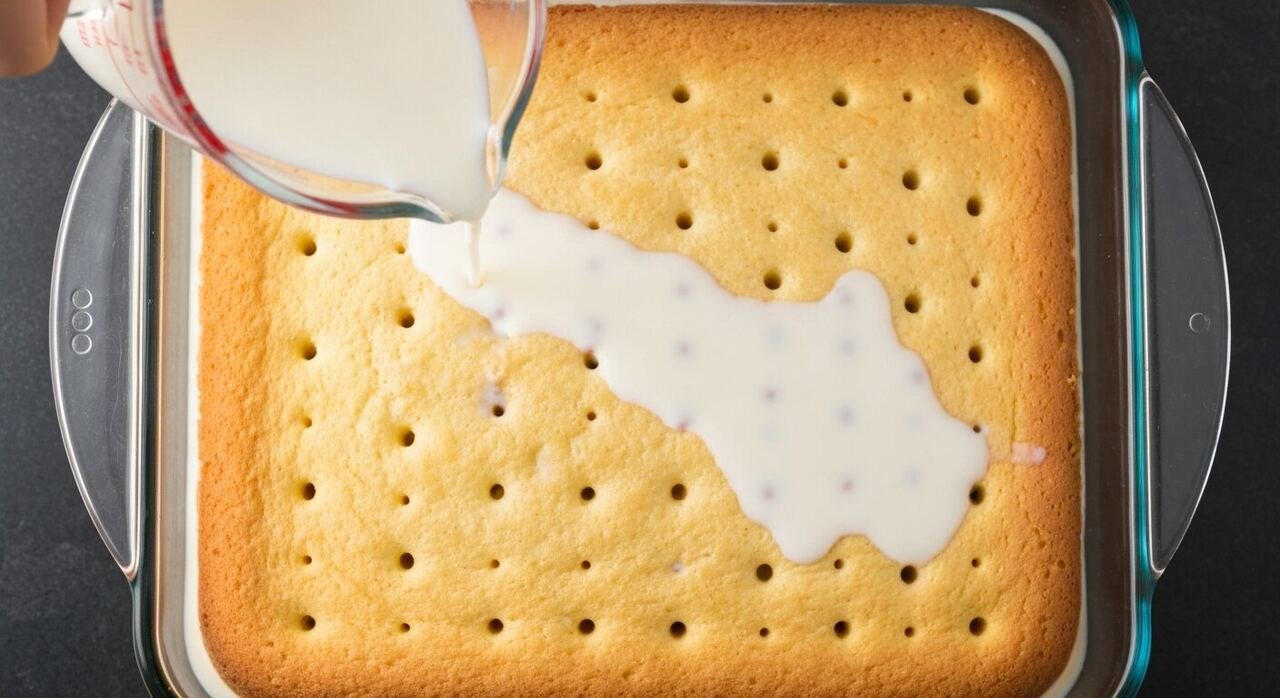
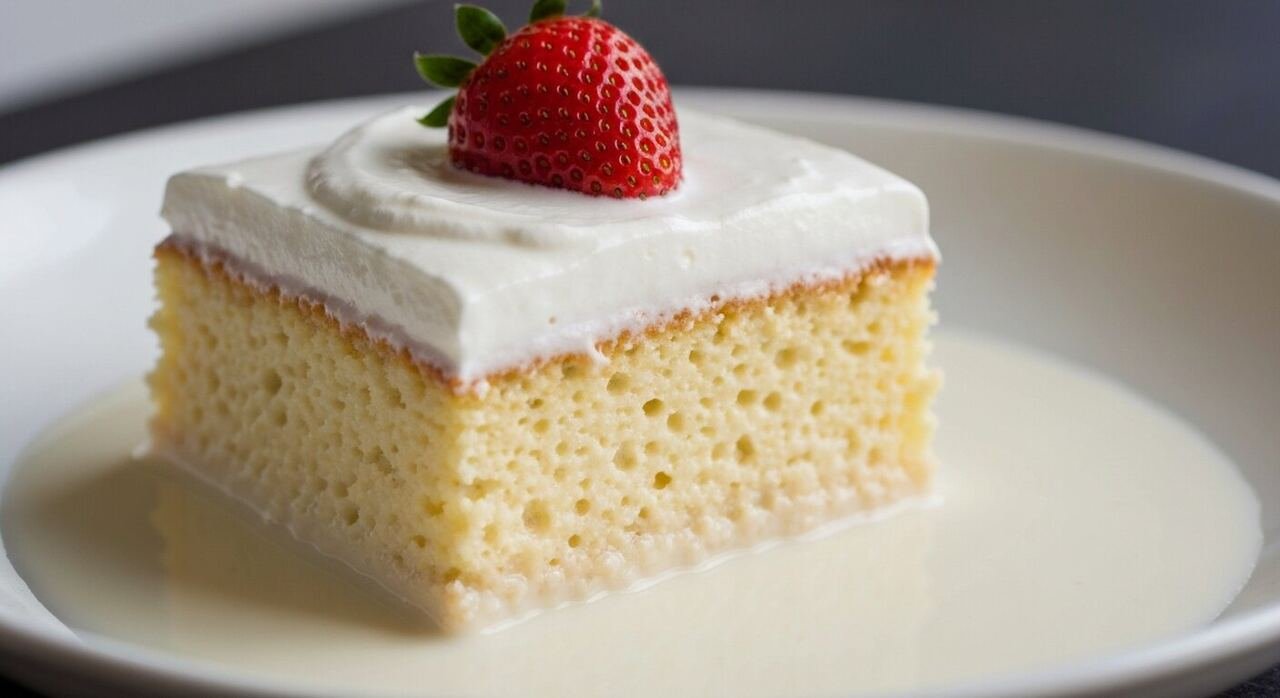
The pouring moment always feels wrong — three cups of liquid over one modest cake — and that feeling is the test of faith every first-timer fails to enjoy. Pierce the cake generously, pour slowly in stages, and refrigerate. Four hours later the pool is gone, absorbed into a cake that slices cleanly and weeps just slightly on the plate, exactly as it should.
Good to Know
Tres Leches Rules
- Overnight is the real recipe — four hours works, but day-two tres leches is deeper, colder, and slices better.
- Whip the topping cold — cold cream, cold bowl; soft peaks, not stiff, so it spreads like a duvet.
- The cuatro leches upgrade — drizzle dulce de leche over the top and tell no one how easy it was.
- Storage — covered in the fridge up to 4 days; it does not freeze well (the thaw weeps).
- This is unapologetically a celebration dessert — rich in dairy and sugar — so a modest slice goes a long way.
Watch It Made
Seeing the egg-white fold and the milk pour makes the whole recipe click — this walkthrough covers every step before you scroll down to the full card.

Video walkthrough via YouTube — tap to play (nothing loads until you do).
The Continental Table Recipe
Tres Leches Cake
Ingredients
The sponge
- 1 cup (125 g) all-purpose flour
- 1½ tsp baking powder
- ¼ tsp fine sea salt
- 5 large eggs, separated
- 1 cup (200 g) sugar, divided
- ⅓ cup whole milk
- 1 tsp vanilla extract
The milks & topping
- 1 can (14 oz) sweetened condensed milk
- 1 can (12 oz) evaporated milk
- ½ cup whole milk or cream
- 1½ cups cold heavy cream + 3 tbsp sugar + 1 tsp vanilla
- Cinnamon or berries, to finish
Method
- Bake the sponge. Beat yolks with ¾ cup sugar until pale; stir in milk and vanilla; fold in the dry mix. Beat whites to soft peaks with the last ¼ cup sugar and fold in gently. Bake at 350°F in a buttered 9×13 dish, 25–30 min.
- Cool 15 minutes, then pierce the cake all over with a fork.
- Whisk the three milks and pour slowly over the whole surface. Trust the recipe — pour it all.
- Chill at least 4 hours, ideally overnight, covered.
- Whip the topping — cold cream, sugar, and vanilla to soft peaks — and spread over the cake.
- Finish and serve cold with cinnamon or berries. It only gets better on day two.
The Celebration Cake of a Continent
Tres leches is proof that the best desserts are acts of confidence: pour an impossible amount of milk over a cake and trust the sponge to hold. Thirty minutes of work, one night of patience, and you have the cake that anchors birthdays from Managua to Mexico City — cold, creamy, dripping at the edges, and gone before the coffee’s finished. Make it the day before. Thank yourself the day of.
Quick Answers
What are the three milks in tres leches?
Sweetened condensed milk, evaporated milk, and whole milk (or cream) — whisked together and poured over a pierced sponge cake.
Why isn’t tres leches cake soggy?
Because the sponge is leavened with whipped egg whites — its airy honeycomb structure absorbs the milk while keeping its shape. Butter or oil cakes would collapse.
Where is tres leches from?
Both Mexico and Nicaragua claim it. Recipes printed on condensed-milk cans in the mid-1900s spread it across all of Latin America.
How long should tres leches soak?
At least 4 hours, but overnight is best — the cake absorbs every drop and slices cleanly on day two.
How long does tres leches keep?
Covered in the refrigerator, up to 4 days. It doesn’t freeze well — it weeps when thawed.
You might also like


Leave a Reply
Join the conversation
You need an account to leave a comment.